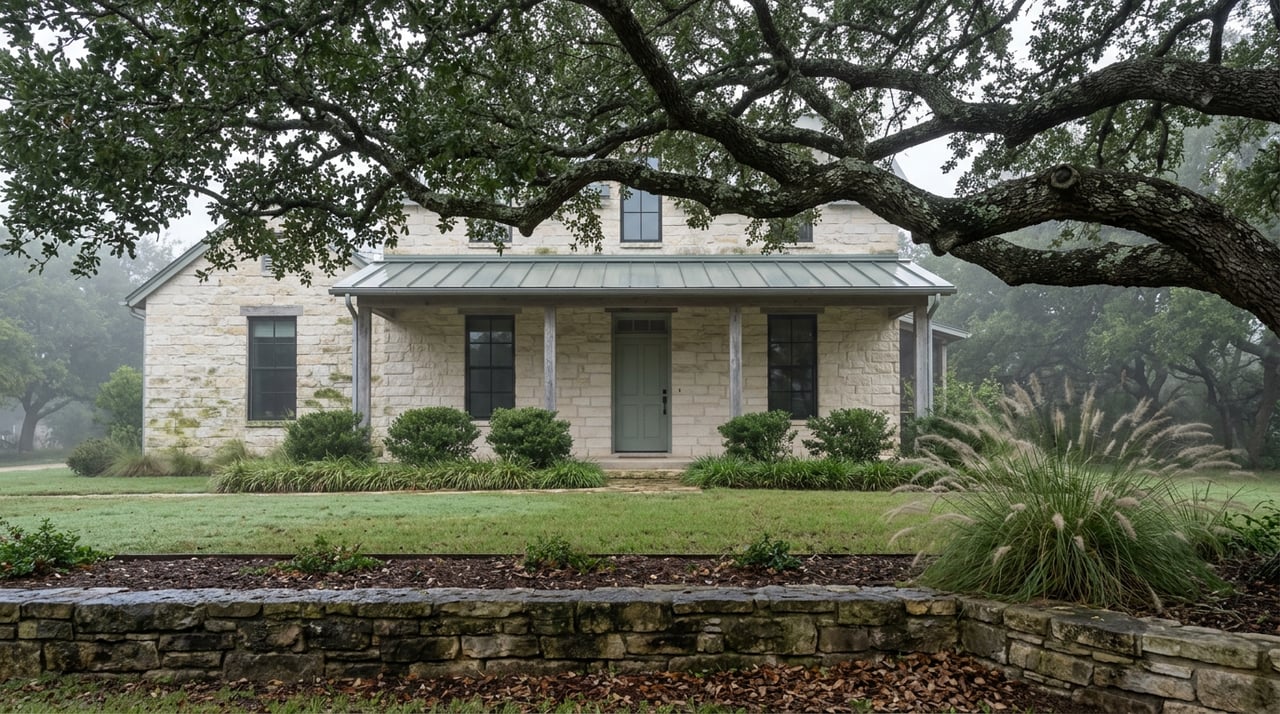
Tarrytown Tree Rules That Shape Your Home Addition
September 3, 2026
September 3, 2026
Most homeowners planning an addition in Tarrytown start with the property line. They pull the survey, measure the setback, and sketch a primary suite or a pool house into whatever rectangle is left. Then an arborist walks the lot and draws a second line, one that has nothing to do with the deed and everything to do with a live oak that was already mature when the house was built. That second line, not the property line, is usually the one that decides what actually gets built.
The line is called the Critical Root Zone, and in a neighborhood where mature oaks are the rule rather than the exception, it is the constraint that catches people off guard during design, not during permitting.
Austin Development Services calculates a tree's Critical Root Zone, or CRZ, using a simple formula: one foot of radius for every inch of trunk diameter, measured at four and a half feet above grade. A 20-inch oak carries a 20-foot radius. A 30-inch oak, common on older Tarrytown lots, carries a 30-foot radius, which means a 60-foot circle of protected ground centered on the trunk.
Here is what that looks like in practice:
| Trunk diameter | CRZ radius | CRZ diameter |
|---|---|---|
| 19 inches (protected threshold) | 19 feet | 38 feet |
| 24 inches (heritage threshold for named species) | 24 feet | 48 feet |
| 30 inches | 30 feet | 60 feet |
Inside that circle, the city does not treat all ground equally. The City of Austin says no impact of any kind is allowed in the inner quarter of the CRZ. Cut and fill inside the inner half is capped at four inches, and across the full root zone at least half the ground has to stay undisturbed at natural grade. Only in the outer half does a builder get real flexibility.
On paper, that sounds like a construction detail. On a Tarrytown lot, where a single legacy oak can sit close enough to the house that its CRZ reaches the far property line, it is closer to a second floor plan, one drawn by the tree instead of the architect.
Austin regulates trees in two tiers, and the difference between them changes what is actually negotiable.
Any tree 19 inches or larger in diameter is a protected tree and needs a permit to remove, no matter its condition. But a shorter list of species, all oaks, Texas ash, bald cypress, American elm, pecan, Texas madrone, bigtooth maple, Arizona walnut, and Eastern black walnut, cross into heritage status once they hit 24 inches. Heritage status is a different conversation with the city.
Tarrytown's tree stock puts a lot of homeowners on the wrong side of that line without realizing it. Tree Scouts reports that live oaks in the neighborhood routinely clear 19 inches, and it is common to find specimens well past 30, which means many of the trees framing a Tarrytown front yard are not just protected, they are heritage.
That distinction is worth checking before an architect gets attached to a floor plan. A 19-inch cedar elm in the wrong spot is an obstacle.
Here is the part that has not made it into most renovation conversations yet. On August 24, 2026, Austin Development Services posted a formal Notice of Proposed Rule, numbered R161-26.04, implementing a 2024 council resolution and recent updates to the tree code. The public comment period runs through September 24, 2026.
The proposed rule does two things worth knowing if you are planning work on a Tarrytown lot right now. It clarifies exceptions for trees under 10 inches in diameter, which mostly helps smaller projects that had been catching unnecessary scrutiny. But it also confirms something arborists have applied informally for a while: the City Arborist can require a larger CRZ, roughly one and a quarter to one and a half times the standard radius, for species considered less resilient to construction impacts. Post oak is named specifically.
Post oaks are not as common in Tarrytown as live oaks, but they are present on some of the older lots, and they do not tolerate root disturbance the way a live oak does. If your lot has one and this rule finalizes as written, the buffer around it gets larger, not smaller, which can shrink an already tight buildable footprint further.
None of this is settled yet. It is in the comment window as of this writing. But if you are timing a permit application around a planned addition, that is a detail worth tracking rather than discovering after your plans are drawn.
If you are adding on to a home you already own, get the tree survey done before the floor plan, not after. An arborist can tell you which trees on your lot are protected, which cross into heritage, and where the CRZ actually falls relative to your proposed footprint. That single step reorders a lot of design decisions before money gets spent on drawings that will not survive the tree review.
If you are evaluating a Tarrytown lot to buy, the listing photos will show you the canopy. They will not show you the buildable envelope underneath it. A quick trunk measurement on the mature trees near where you would want to build gives you a rough sense of how much of the lot is actually available before you waive an option period.
If you are prepping a Tarrytown home to sell with a planned addition already in mind, it is worth having the tree conversation before you list rather than letting a buyer discover the constraint during their own due diligence. A buyer who finds out the primary suite they pictured sits inside a heritage oak's root zone is a buyer who renegotiates, or walks.
Does the September 24 comment period mean the rule is already in effect? No. It is still in public comment as of this writing. Nothing changes automatically on that date, but it is the point at which the city could move toward finalizing the rule, so any project with a tight timeline should account for the possibility.
What if the tree on my lot is under 19 inches? It falls outside the protected tree category entirely under current code, though the proposed rule's clarification on trees under 10 inches suggests the city is still refining how the smallest trees get treated during site review.
Tarrytown's oaks are part of why people want to live under them in the first place. They are also, more often than most renovation budgets account for, the reason a project's footprint looks different from what the property line alone would suggest. Knowing where that second line falls before you draw the first one is the difference between a renovation that moves on schedule and one that spends its first season in the tree review queue.
If you are weighing a Tarrytown purchase with an addition in mind, or getting a home ready to list with renovation potential as part of the pitch, Brande Draper has spent enough seasons inside her own renovations to know which constraints show up on a survey and which ones only show up once the arborist walks the lot. Let's Connect before the floor plan gets drawn, not after.
This article is general information, not legal, tax or financial advice. Consult a qualified professional about your situation.
Stay up to date on the latest real estate trends.

Get assistance in determining current property value, crafting a competitive offer, writing and negotiating a contract, and much more. Contact me today.